Welcome to the February Newsletter! |
How Oxen Helped Build a Market Garden in Sweden
“Kärleken drar som tio par oxar” is an old Swedish saying that translates to “Love has the strength of ten pairs of oxen.” For centuries, oxen were the heart of Swedish agriculture, but they disappeared with the arrival of tractors in the 1950s. Today, the slow hoofbeats of oxen can still be heard on my farm - not out of nostalgia for the past, but to create a better future. Working with oxen is my daily practice of environmental and animal activism.
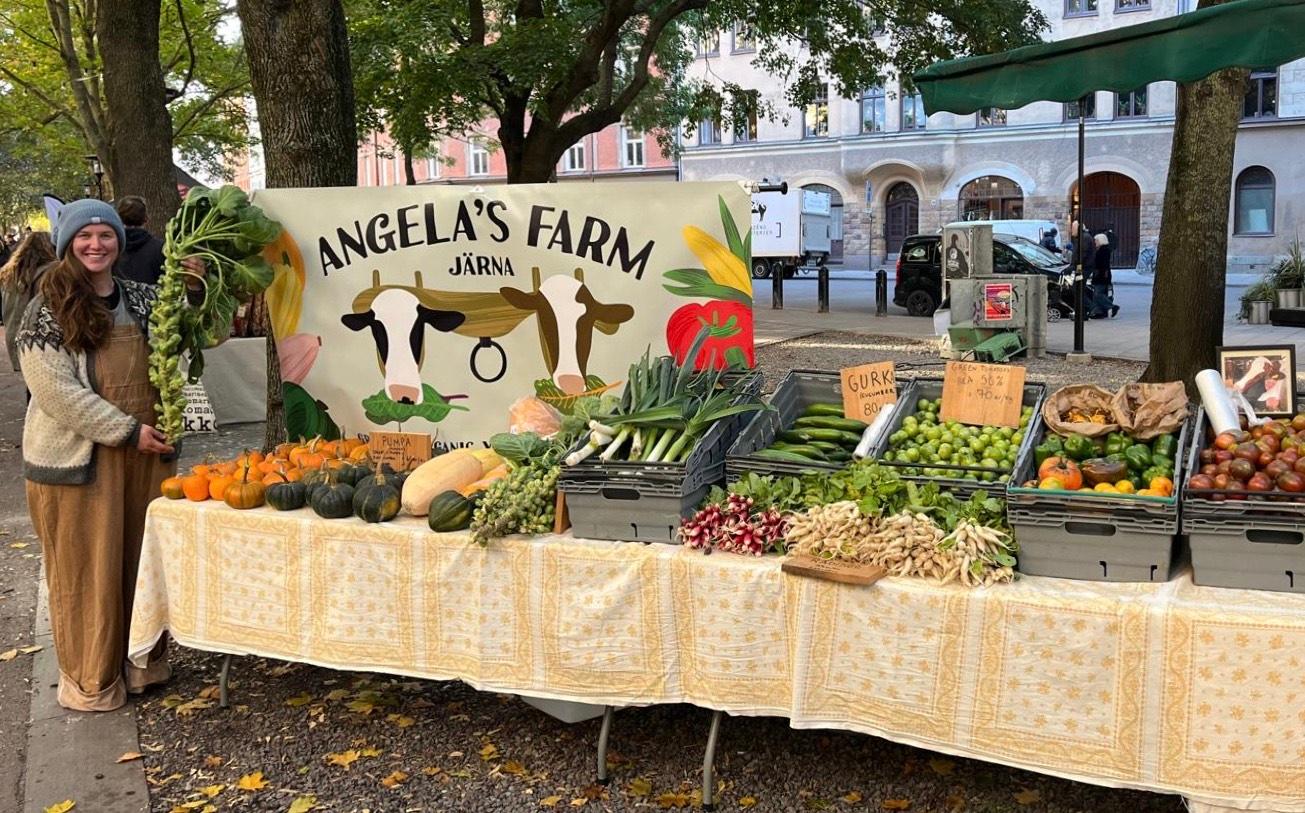
My name is Angela, and I own a small organic vegetable market garden near Stockholm, Sweden. From August through November, I sell heirloom varieties of tomatoes, pumpkins, squash, swiss chard, radishes, kale, lettuce, herbs, and whole chili pepper plants at the Stockholm Farmers Market.
I started farming as a business in 2021. I stepped off the academic path in environmental sciences to take action for a more sustainable food system. Every organic vegetable that I can provide for my community is one less that comes from conventional greenhouses in Spain. One tomato at a time, I work to help decrease the carbon footprint of food traveling across Europe, the eutrophication of the Baltic Sea, and the impacts of pesticides on biodiversity.
Growing vegetables is my “job”, but the real passion of both my farm and my life is my small herd of rescued cattle. In the barn that my partner built from the wood that he milled himself (yes, I'm bragging), live my two milking cows and two oxen. Sunshine and Marigold were discards from conventional dairy operations. They didn’t meet the rigorous standards the industry requires, but now they thrive as family cows. They are in the fourth year of their lactations, and together they still generously provide 15-19 liters (4-5 gallons) of high-fat milk per day. Sales from their milk, butter, ghee, and cheese easily cover the winter costs of the entire herd’s haylage, straw, and sawdust.
Madhu (Sanskrit for “sweet” or “honey”) and Chandra (the Hindu moon god) are my pair of four-year-old oxen. They are the most common dairy breeds in Sweden - half Swedish Red (SRB) and half Swedish Lowland (SLB). If I were to equate them to more common breeds, they are essentially half Guernsey and half old-version of Holstein. They are BIG, long-legged, people-loving sweethearts. |
As an environmentalist, I have always been drawn to the benefits of using draft animals because of how lightly they tread on the land. Literally, their hooves compress the soil much less than tractors, but even in a much larger sense, their global “footprint” is far less. We don’t depend on fossil fuels, and there are no waste products to send to landfills. Their manure becomes the rich compost used to grow vegetables. I find it so poetic that even after my two oxen live out their natural lives, their bodies will simply return to the earth; the only evidence they will leave behind is the healthy soil they built and the metal buckles of their harnesses.
In truth, my small-scale production doesn’t actually require oxen - one donkey could probably get the job done. The most important point for me is to positively engage them in work. This benefits their physical health, their mental well-being, and, of course, they help me run our shared home.
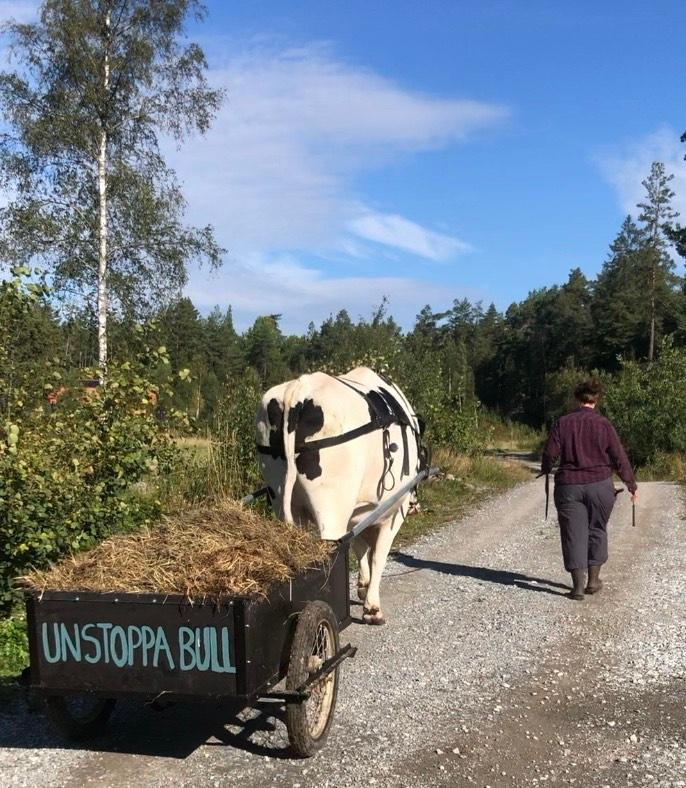
In the growing season, we harrow and cultivate vegetable beds, move compost around, and mow the pastures. In the winter, we plow the snow from the farm driveways, haul fallen logs home for firewood, and go for sleigh rides. Year-round, we use our small two-wheeled cart to do simple errands like buying sawdust and grains from a farm down the road, and emptying moldy food from the round bale feeder.
I almost always choose to work them as singles rather than as a pair. They are plenty strong enough alone, the tight layout of my gardens are better suited to one ox, and I naturally prefer connecting with one individual at a time. Each ox has his own personality and strengths, and by working one-on-one, I have the luxury of choosing the ox who best fits the task. If I want power, speed, or need to do repetitive work, I go with Madhu. When a task requires detailed movement, a slow and even pace, or frequent periods of time where I have to leave him standing to adjust the load, then I work with Chandra.
Their eagerness to work and the depth of their companionship have surpassed all my expectations. I am profoundly grateful to Madhu and Chandra for their patient and adaptable natures. They are my first team, and the three of us have learned our skills together, step-by-step. Even though we are certainly still beginners, every day they prove that oxen are not just a relic of a romantic past. I believe that together we are stepping forward toward a sustainable food system built on respect for the earth, respect for our local community, and, of course, respect for draft animals.
-Angela Patterson |
A Passion That Persists
And People Who Light the Path
Hello from wintry Western Massachusetts. I hope this finds you cozy enough to sit and read this newsletter. I was asked to write about how I came to work with draft animals and how they fit into my life. Though initially a bit stumped, I decided to share in case it helps someone else find their way, or feel a little less alone in the process. My journey is very much a work in progress.
I was a horse-obsessed kid in a family that did not have horses. Thankfully, I had parents who became very supportive, along with access to a raggedy little barn in coastal MA, where kids earned their stripes through work and learned to ride. With no formal management, a bunch of us kids and a few adults cared for two full barns of school horses and some boarders. It was a pretty feral scene, which meant learning by doing — guided by a few seasoned mentors who instilled some old-school horsemanship.
From lessons and drill teams, to barn bullies, buddies, nerdy horse-care school projects, first aid, troubleshooting, trail and beach rides, tragedies and triumphs — I was all in. I got into showing, braiding, and hauling horses to shows, and always imagined my future would be with horses. I loved it with every ounce of my being. Eventually, though, I realized that a career in the hunter/jumper world I knew so well was not a viable path beyond junior riding years. When my horse was sold, that chapter closed. I deeply missed horses and sought them out wherever I could as I moved into adulthood.
Work and motherhood became the primary focus of my twenties. I made my home in rural Western MA, which embodies deep agricultural heritage — something I hadn’t known growing up on the coast. A family friend, Bruce Marshard, had been the exception: with a pair of Percherons, the only draft horses I knew as a kid. They logged, plowed snowy driveways with a V-plow, and dragged the arena at our county fair before our drill team performed. I admired those horses but never imagined working with drafts myself. At the time, the disciplines felt more rigid. It’s refreshing to see the versatility and interdisciplinary horsemanship today.
Living in Western Massachusetts exposed me to working farms that told stories — generational farmers and loggers whose cadence of speech felt like a portal to another time. Not lost, but still very much here. I also encountered first-generation farmers working with draft animals, including David Fisher right in my hometown. As my worldview took shape, each brush with draft power tugged at my horse-loving soul. It simply made sense, and steadily began shaping my dreams.
The hardest part was finding a pathway. As a working single mother, I wasn’t exactly a candidate for an apprenticeship, so the dreaming and longing became a slow burn. I took side jobs on farms and helped farmers with draft animals whenever I could. Discovering DAPNet and the Green Mountain Draft Horse Association felt like finding a magical realm full of inspiration, generosity, resourcefulness, and community. Even as a newcomer, I felt I had found my people, or at least knew I wanted to be among them.
Some key steps included an immersive workshop at Fair Winds Farm with Jay and Janet Bailey, and a GMDHA driving clinic with my Dad, where we met people who would become mentors and friends. I wasn’t sure I would ever truly become a teamster — coming in as a newbie and as a woman — but a few key people encouraged me to keep stepping up.
I said yes to nearly every invitation. Phil Warren welcomed me to tag along, hold the lines, and meet up at the Mid-Ohio Spring Sale, where we watched horses for days. I bought a teal draft halter to manifest my future horse, followed by a team set of Phil’s old leather harness. (Three days later, unknowingly, I was offered my horse!) Pat Palmer and Macey Ross welcomed me on their trash route and offered insight as I explored starting a business in my town. I devoured Lynn Miller books, nerded out at Field Days, drove solo to Horse Progress Days, and showed up wherever I could — even when I felt like an outsider, unsure if I would ever cross the threshold into truly doing this work.
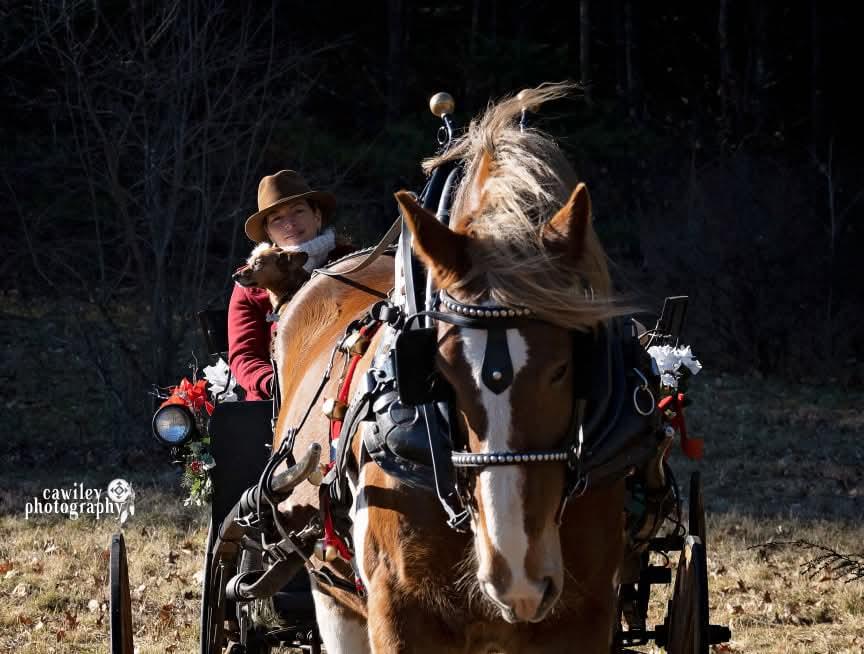
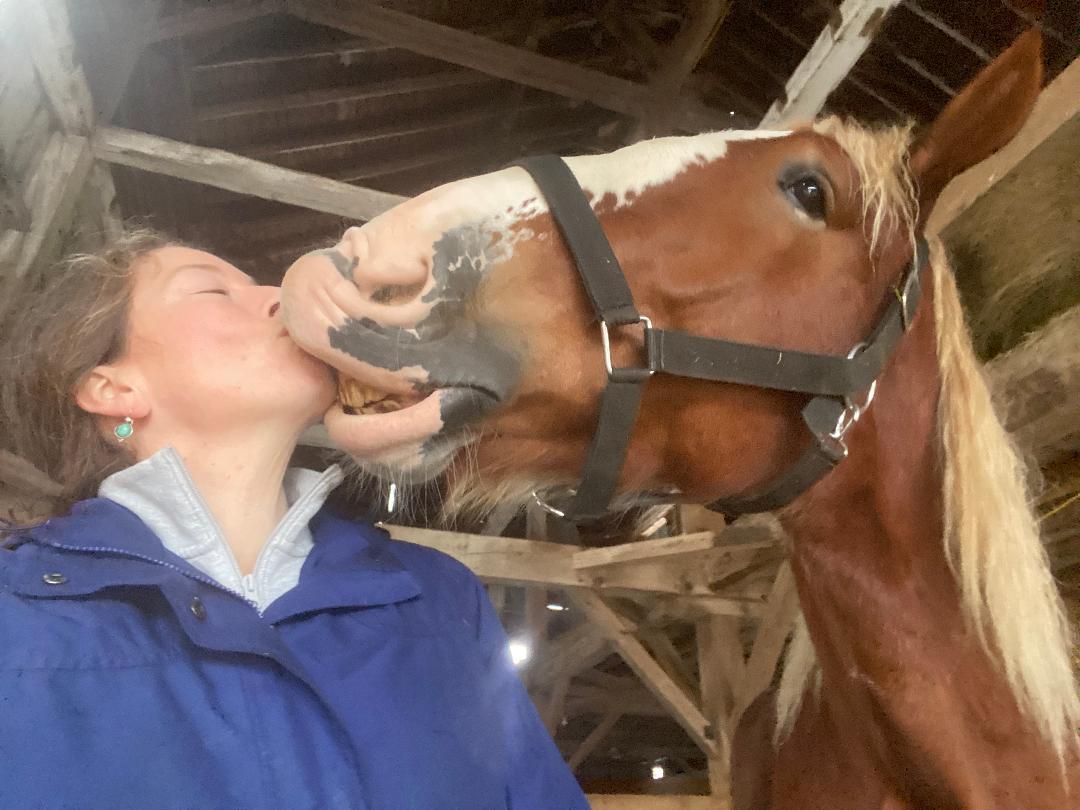
During the pandemic shutdown, space finally opened in my life. My daughter was older, my work paused, and mentorship became the next step. Through a DAPNet suggestion, I reached out to Pam Rickenbach and asked if I could volunteer with her herd. That winter, I spent countless days with her horses — routine care, fitting harness, ground driving, hitching, and long conversations about history and context. Eventually, Pam placed an incredible semi-retired carriage horse into my hands: a Spotted Draft named Tomahawk, or “T-Bird.” He became my first draft and showed me what I was made of. He knew far more than I did, tested me plenty, and over time we became a dream team.
That spring, I took a job with Carriages of Acadia. I couldn’t fathom how it would work — a teen, a horse, a dog, a home — but miraculously everything aligned. My horse and I spent the summer in Acadia National Park, where he was “on vacation.” I worked long days caring for and driving many teams for miles on the historic carriage roads, living in close quarters with coworkers who became mentors and friends. Emily and Mike Carpenter pushed me and believed in me. It was immersive, demanding, humbling, and deeply rewarding — my Draft Horse Practicum, an experience that would have taken years to replicate at home.
If there’s one takeaway I hope to impart, it’s the value of mentorship and community. These powerful animals generously place their trust in our hands, and there are always risks, even for lifelong teamsters. Seasoned allies make all the difference — for safety, success, and support when things go sideways. |
Since returning home, my herd has grown and changed. Tomahawk was joined by Quinny, a young Belgian, Moonshine, a mini-hinny and Chief, a seasoned Percheron. We’ve done meaningful carriage work in our community. More recently, I’ve navigated profound loss — saying goodbye to two beloved older drafts, and facing injury and uncertainty with the younger one. These hardest parts are often experienced quietly, yet they are part of the promise we make to these animals who give us so much.
The momentum of beginning my work with draft horses was life-changing, and there is much I still hope to do. For now, I’m in a quieter, liminal space — uncertain of what’s next exactly. Still, every day I spend with these animals is a gift. Each challenge and success makes me a better horse person. Sharing these remarkable creatures with others who are drawn to them is deeply rewarding. They connect people to something larger — something felt rather than explained. The horses sure work their magic, whether I’m on the lines or on the ground. And this, I know, is at the heart of the work I will continue with them.
-Towner Smith |
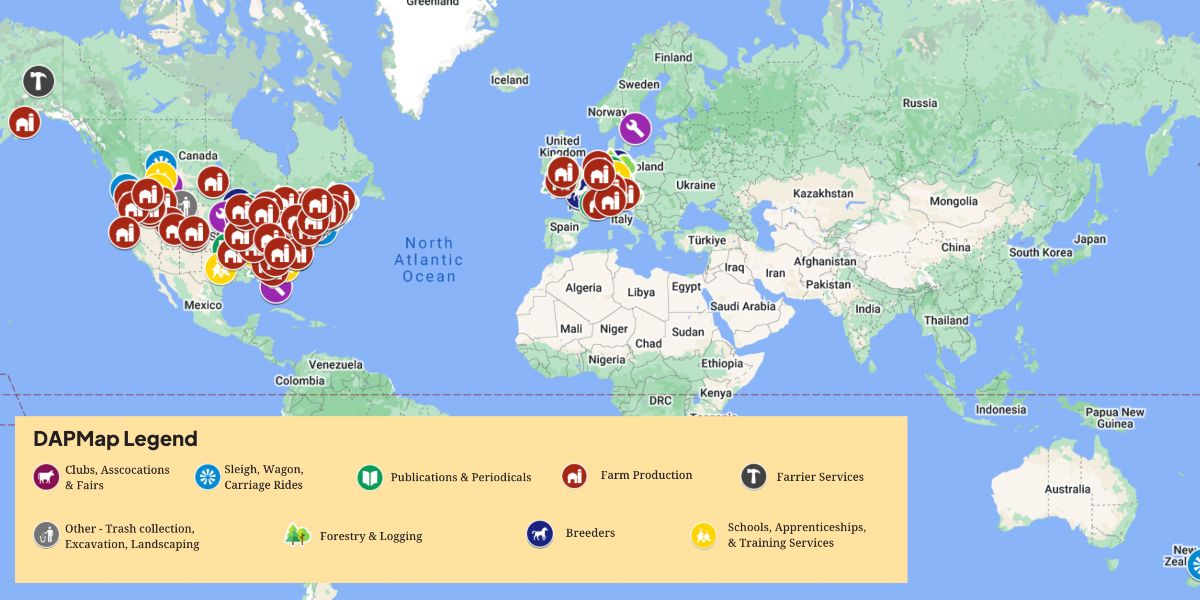
Welcome to the DAPMap!
This month we are introducing our DAPMap places in Germany!
NEW- Johann Oemler's Zugrinder- Johann works with an old German breed. Red Highland-Cattle. They are somewhat comparable to Devons. Johann started with logging firewood as a hobby. Johann is always willing to show and teach people the ways of working with draft cattle that I learned. You can contact them here.
Zugrinder Döring- We breed the endangered Rhaetian Grey cattle and harness the cows. We also have a team of oxen, which is used for all kinds of events (parades, medieval markets, farmers' markets, etc.). We enjoy training people and animals and offer internships. You can contact them here.
Kuhnweiler Hof- PhD written on modern draft horse use in organic farming; international networking; still engaged in science concerning draft animal use. Contact them here.
Arbeitspferde Höbel- Farming and forestry with Bavarian draft horses. Further we offer services with our horses: carriage rides, events for schools and groups. Contact them here
Starke Pferde- Magazine to promote the use of draft horses and other working animals. Visit their website here.
Want to be featured on the map? Fill out the form today! |
Committee Updates
Education :
This month the education committee is beginning to hone ideas from the December board retreat. Our current focus is on collaborating with partnering organizations. We want to understand their needs and goals, and creating open dialogue so that we can find new opportunities to work together and strengthen one another.
Events :
This month the events committee appointed work groups for specific needs such as coordinator roles and streamlining the form for potential field days teamsters and educators. Discussions were had on intensives and other topics of interest to bring to the table for this year's field days.
Executive :
Alongside ensuring that every committee is fulfilling its mission in support of draft animal power education, the Executive Committee has been very busy this month. We have been preparing interview processes for upcoming hiring, while ensuring alignment in our shared perspectives and expectations regarding contracting. We also worked on strengthening connections with past board members by creating a dedicated webpage and meeting with them directly. Following these discussions, we agreed to establish an Emeritus Committee to provide additional guidance and support in board decision-making.
We have also been reflecting on how the board continues to evolve in a rapidly changing environment and how we position ourselves publicly. Conversations have begun about transitioning to a new email system once we are more fully familiar with the CRM implementation, which has already proven to be highly beneficial.
Communications :
The Communications Committee has been busy getting ready to attend events in the summer of 2026. This year we are excited to have teamsters in the logging section of the Common Ground Fair. We are also working with new consultants on podcasts and an educational video series.
Finance :
We’re finalizing the 2026 budget and meeting with the bookkeeper at Morning Ag Clips (MAC), to streamline things between the network, the bookkeeper, and make sure all of our categories match to bring clarity on both sides. |
It's February and that's the perfect time to become a DAPNet member or renew your membership!
Your support last year helped young people and their teams (as well as 300 other participants!) come to Field Days, paid for the web services that brought 4 DAPChats to community members around the globe, and revamped our website to facilitate more online programming.
By being a member you show us that this culture and community is important and relevant! Thank you for being a part of this community! We couldn't do it without you!
Members receive some perks as well - including 10% off an order of $100 or more at High Mowing Organic Seeds - just in case you've been dreaming of Not Winter.
Find out more, Join or Renew here ! |

|
Have you had a chance to listen to the Draft Animal Power Podcast? We have published several different episodes with interviews of people working with draft animals in the USA and Germany! Find us on any podcast listening platform and subscribe to be the first to know of a new episode! |
|
|