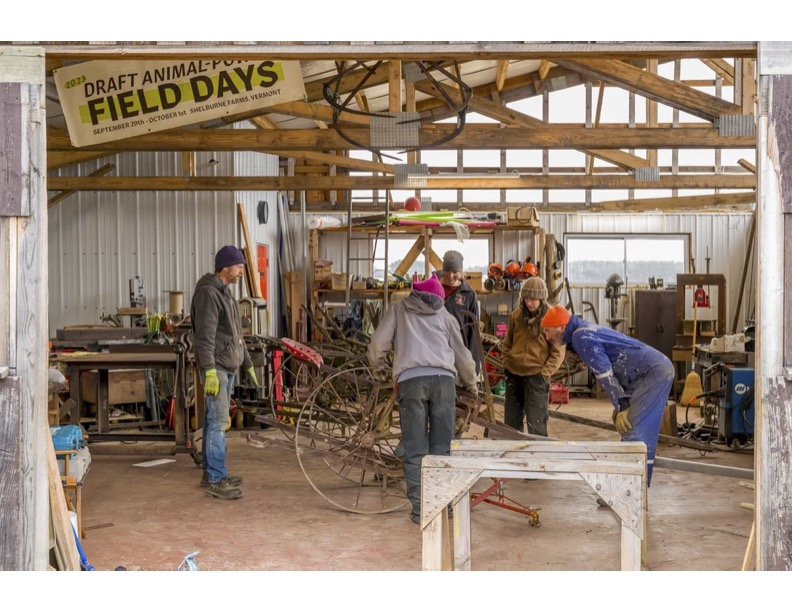
Becky Frye, Julia Ramsey, Maggie Smith, Michael Glos and Donn Hewes examine each cultivator brought to Northland Sheep Farm for the workshop and assist each other in the task of repairing the hundred year old machines. Marathon, NY
It always amazes me that some of the horse equipment I use is likely close to 100 years old and is still working. My McCormick Deering cultivator(s) are no exception. This cultivator is very versatile and a pleasure to operate. I have tolerated a lot from my cultivator over the years just assuming that since it was old that I shouldn’t expect much more from it. Although not every individual machine has stood the test of time, some routine maintenance and repair can keep many working for another generation or more.
Last March a group of teamsters assembled at Northland Sheep Farm to spend two days working on cultivators. I brought two that I thought were fully functional and didn’t need much. Maggie Smith brought hers, that while functional, needed some work. Becky Frye worked to make one cultivator out of the half a dozen non-functioning “parts” cultivators she had parked outside.
As the wind blew and the snow fell outside, six of us worked together to take the wobble out of the wheels and make the many levers move again. Wheels were scavenged from parts machines and new springs and washers were installed. We even built a new metal tongue so the cultivator designed for larger breeds would work better with my smaller horses (Fjords).
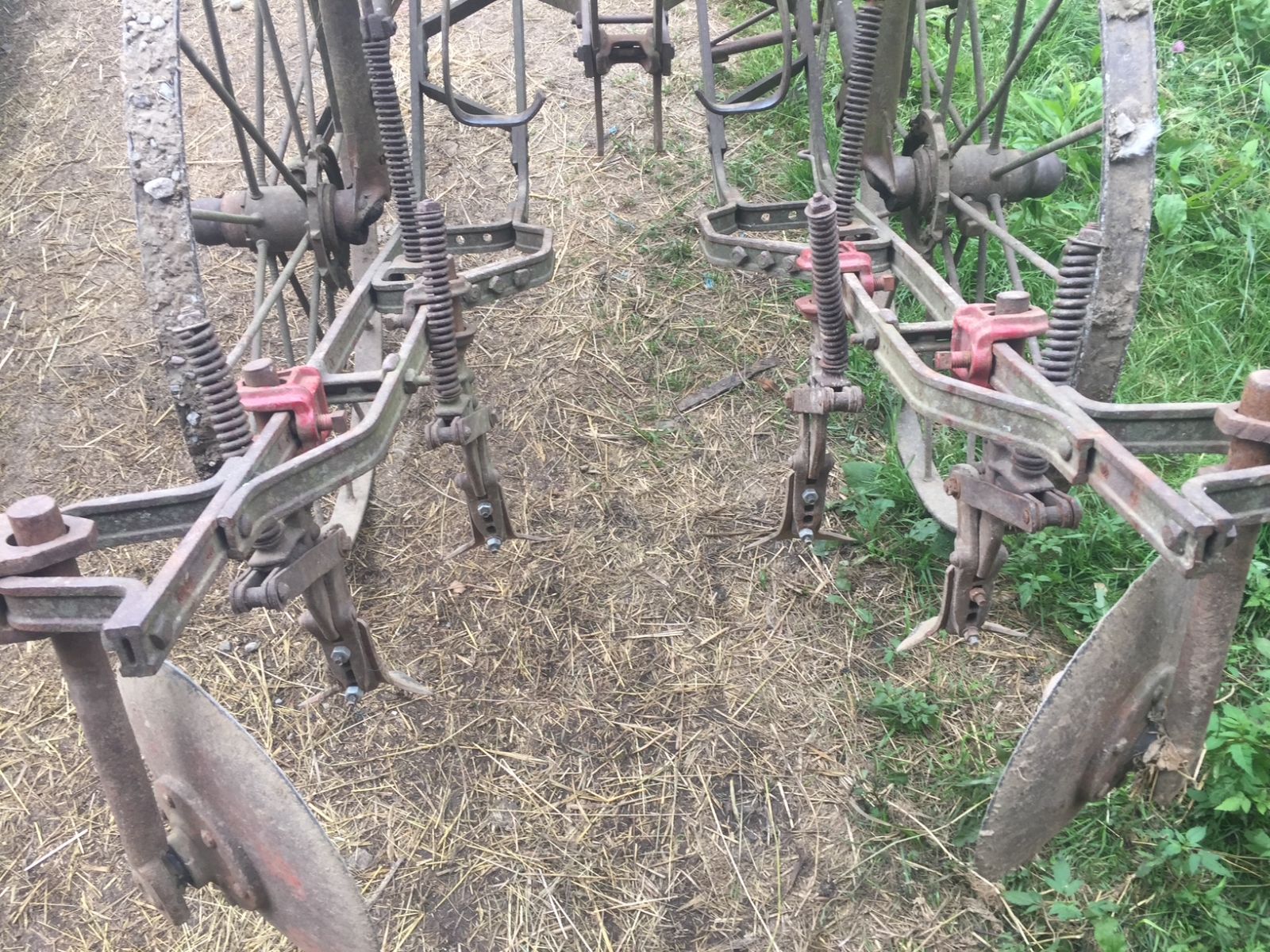
Shovels and Discs set up for potato hilling.
Photo Credit: Michael Glos.
Michael Glos and his Norwegian Fjords hill potatoes with his recently tuned up sulky cultivator.
Photo Credit: Michael Glos.
We will be doing it again on April 4th and 5th at Northland Sheep Dairy, Marathon, NY and I invite you to join us. Visit www.teamsterschool.com for more information.
The Southeast Teamster Gathering would like to thank our following sponsors:
Branch Mountain Farm
Agricultural History Society
Turner Farm
A. A. Carriage
The Berry Center Farm and Forest Institute / The Bookstore at The Berry
Speckled Hen Garden
Registration is open for this event! We are still accepting sponsorships. You can find out more here.
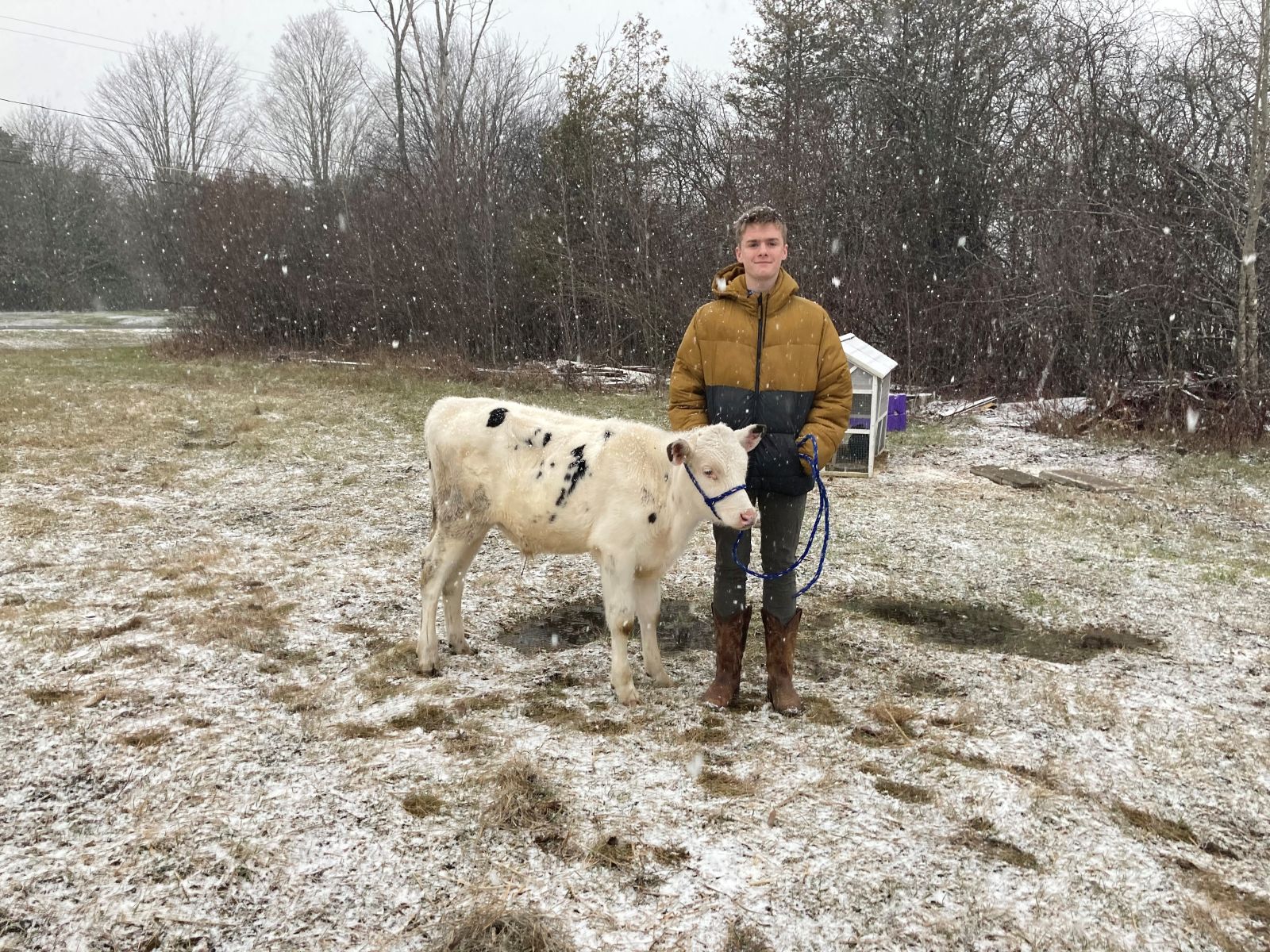
Troy with Bruno as a calf in 2020.
Photo Credit: Anna Knapp-Peck
Learning from Bruno- The Process of Training an Older Animal
By Anna Knapp-Peck
Bruno came into my life in December of 2020. It was the middle of the pandemic and that was a rough time for my kids, especially my son Troy. He’s a social guy and very active in sports. The loss of contact with his friends and teammates was hard. One day, while he was supposed to be doing remote work, he found a calf for sale on a buy/sell group. He asked if we could get him, expecting me to say no. Occasionally, I say yes, and we went on a two-hour road trip to get a weaned Holstein steer with poor conformation.
Troy taught Bruno to lead some and spent a lot of time with him during that first year. Then the pandemic was over, and life resumed. Troy finished high school and went to college and Bruno was left out to pasture. Eventually Troy moved into his own place, and the question of what to do with Bruno had to be decided. I acquired a four-year-old steer with no education. Bruno and I went back to school.
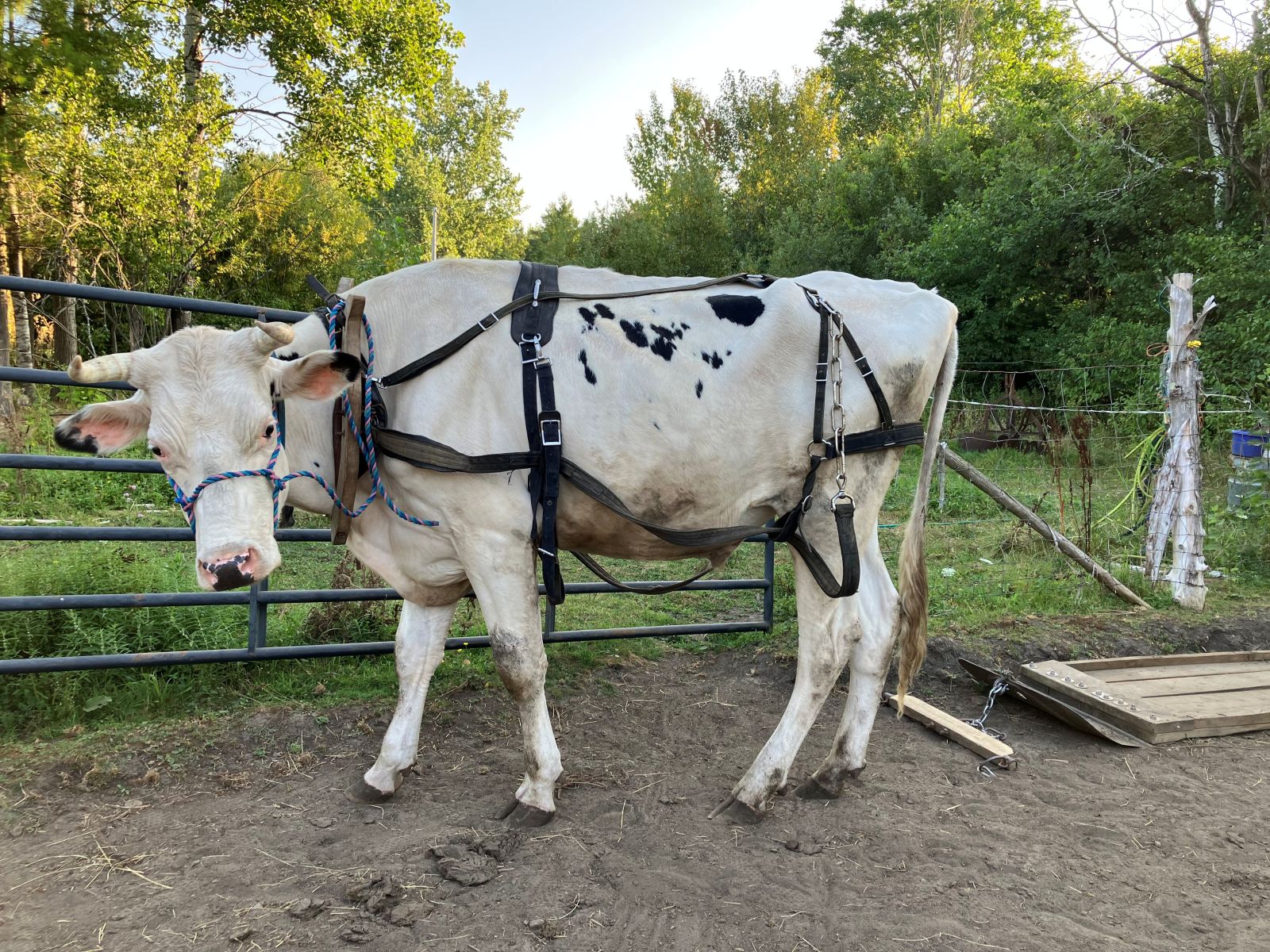
The first thing I realized was that working with an older animal needed a different approach than I use for training calves. The first few months were spent tying Bruno to a tree and putting the harness on and taking it off. He learned to be comfortable with the weight of the harness and trace chains making noise and bumping his legs. He began to wait at the gate, and liked being groomed and eating hay while wearing the harness.
After Bruno became comfortable with the equipment, we took walks around the pasture wearing the harness. These walks helped teach him and reinforce the basic commands, ‘whoa’ being the most important. I always work with him in a fenced area, if he gets away, he can’t hurt himself or others. He is a large animal, as much as I trust him, I am always cautious. I added a single tree on to the traces, so he would become accustomed to the noise.
Eventually I added a small car tire and then a small log. I didn’t use an ox goad or a whip while working with Bruno, just the halter. He became comfortable and a little complacent. He wouldn’t run away, but he didn’t always want to move either. I found that he likes horse treats, and I began using a practice dog trainer’s call luring. I put the treat in my hand, and he would follow the movement. After he pulled the log a distance he got the treat. That was just a training tool; I no longer use treats when I work with him. It was an effective method early on to get him to move forward.
With time I introduced the stone boat and the ox goad, and Bruno began the important work of clearing the pasture. We have no grass and feed hay year-round. The pasture was thickly forested when the fence was built, now the trees are dying, and the ground is covered with dead branches. I use Bruno to collect the branches on the stone boat and move them to a brush pile. The load is light for the size of the animal, but the work is meaningful.
Bruno at work.
Photo Credit: Anna Knapp-Peck
I went into this process with few expectations and Bruno has surpassed them all. He is the biggest ox I have, but he is gentle and willing. He always tries to do what I ask. For liability reasons I don’t plan on taking him to off-farm events, he isn’t comfortable with new people. I have realistic goals for his progress. Bruno has taught me more than I have taught him. With patience and creativity older cattle can be trained to do useful work.
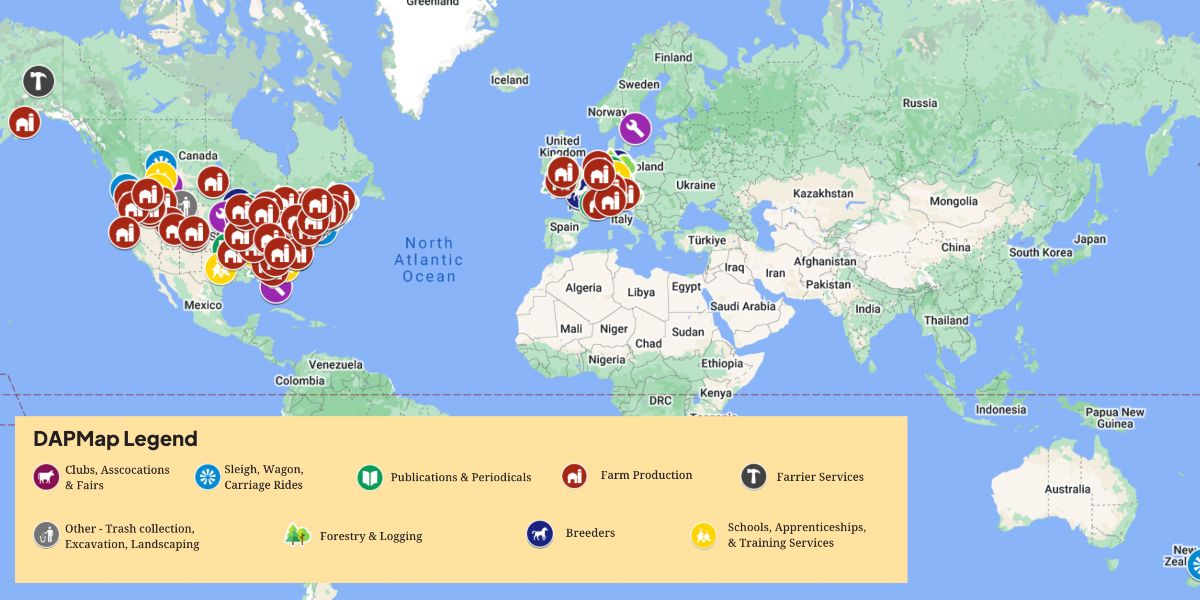
Welcome to the DAPMap!
This month, we are diving into our DAPMap Club, Associations & Fair section!
NEW- Prommata-PROMMATA is a french non-profit organization wich support and encourage farm agriculture, through the development of modern draft animal uses , by carrying out research and innovation in Modern Animal Draft Agricultural Equipment (MADAE), by promoting animal traction, by offering as many people as possible equipment adapted to high-performance, agro-ecological farming, and by passing on our know-how through a wide range of practical training courses and international missions. You can contact them here.
B & B Carriage Service- We offer wagon rides to the local churches and other nonprofit organizations. Weddings, Anniversaries, and many types of farming... plowing, mowing and raking hay, harrowing, stalk cutters, etc. You can contact them here.
European Brabant Registry of America- The mission of the European Brabant Registry of America is to preserve and maintain purebred European Brabants through the use of existing registry information, ancestry tracing and DNA profiles of imported European Brabants and their offspring, thereby providing enthusiasts and breeders the ability to search for and register purebred horses in North, Central and South America. Contact them here
Broken Yoke Ranch- Cattle farm, Oxen for work/movies. Contact them here.
Want to be featured on the map? Fill out the form today!
Planning for this year’s Field Days is well under way! This month we are smoothing out details for tent rentals, a potential dance floor and other down and dirty details! Coordinators have been assigned to their roles and applications are open for Teamsters and Presenters to apply. If you have animals and or something you’d like to bring to the table at this year’s Field Days, you can fill out the form here.
Communications Committee
The Communications Committee is working out the details for the upcoming video project. We are reviewing applications and will begin to interview people for the role of web designer. The committee is also improving the process of putting out the newsletter, and planning for upcoming events at the World Draft Cattle Symposium and Common Ground Fair.
Executive Committee
This month the Executive Committee hired three new people to work with us on various projects.
We now have a videographer working with us to produce innovative educational content featuring members of our organization. We also brought on a podcast producer who will help us put more episodes out there...we know many of you have been waiting for them impatiently!
We also welcomed a project manager who has already been putting a lot of work into making the organization better, especially when it comes to communications and backing up our shared drive (and the million folders and pictures in it).
While this organization already has many years under its belt, the amount of information we’ve gathered over time has grown exponentially. Because of that, a bit of cleaning up and organizing is definitely needed.
Education Committee
The Education committee is working on developing resources and support for member-led educational opportunities as well as exploring partnership opportunities with other educational facilities later this year.
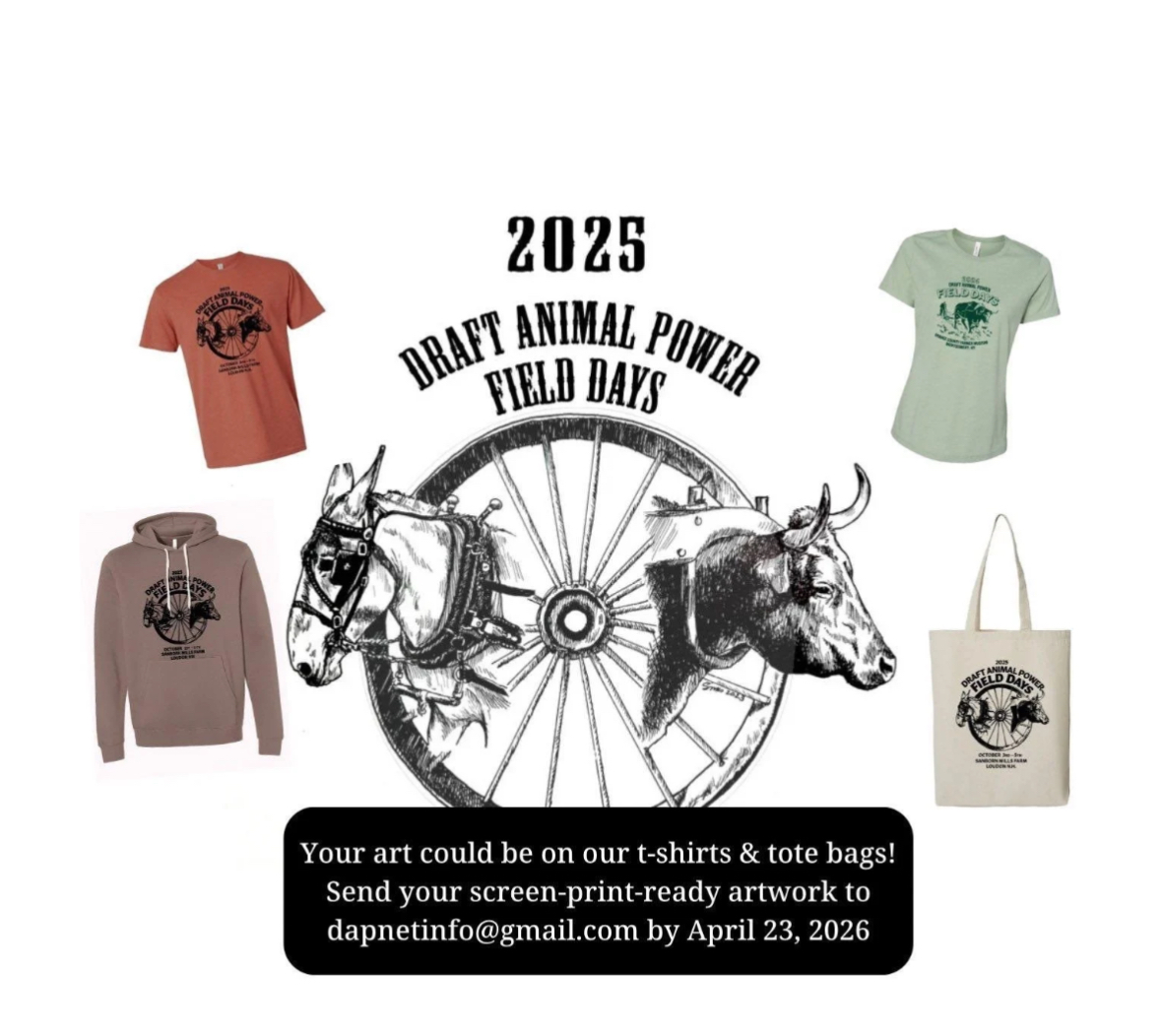
2026 Draft Animal Power Field Days Art Contest!
ART SUBMISSION DEADLINE: April 23, 2026
Submit your art now, we love to see it!!
Classifieds
Horse Teamster / Farm Hand
Sanborn Mills Farm
7097 Sanborn Road • Loudon, NH 03307
www.sanbornmills.org
Position Overview
Sanborn Mills Farm seeks a highly skilled and experienced Horse Teamster & Working Farm Operator who brings their own well‑trained draft horse team. This mission‑critical role supports the farm’s agricultural, forestry, and educational programs through the safe and effective use of horse‑drawn equipment. The teamster also contributes to broader farm operations beyond horse work and serves as a core member of the Farm Team. Work includes field preparation, logging, transportation, and public‑facing activities such as wagon rides, sleigh rides, and special events, as well as routine farm tasks—garden work, fencing, animal chores, and seasonal projects completed without horses.
The ideal candidate demonstrates a deep commitment to animal welfare, strong situational awareness, and the ability to assess and respond to horses’ needs in real time. This role also supports the farm’s mission by teaching and mentoring students, interns, and guests in traditional horse‑powered skills. Experience in hay production, animal husbandry, and horticulture is required.
Key Responsibilities
Feed, water, and groom horses daily.
Drive draft horses for farm work, logging, wagon rides, sleigh rides, and special events.
Maintain tack and all related draft equipment in safe working order.
Provide a safe, enjoyable, and educational experience for students, visitors, and workshop participants.
Follow all safety protocols for animal handling and public interaction.
Assist the Farm Team with animal chores, garden maintenance, fencing projects, and hay production.
Perform grounds and seasonal maintenance.
Support cross‑department operations as needed.
Qualifications
Proven experience training and safely driving draft horses.
Working knowledge of both conventional and historical farming practices.
Ability to operate conventional farm and logging equipment (e.g., tractors, chainsaws).
Experience with animal husbandry for multiple species (chickens, sheep, pigs, cattle).
Mechanical and carpentry skills are preferred.
Ability to work outdoors in varied weather conditions.
Willingness to participate in rotating weekend coverage.
Experience teaching or engaging with the public through workshops, demonstrations, or outreach.
Work Environment & Schedule
This position is based on a historic, working farm that operates year‑round in a variety of weather conditions. Work is primarily outdoors and involves physical labor, interaction with animals, and engagement with students and visitors. The role requires comfort working around draft horses, farm equipment, uneven terrain, and active workshop environments.
The schedule varies seasonally based on farm needs, program activity, and weather. Flexibility is essential, including early mornings, occasional evenings, and rotating weekend shifts. Seasonal demands—such as haying, logging, and public events—may require additional hours. Sanborn Mills Farm maintains a “one mission, one team” culture where staff support one another across departments as needed.
Compensation & Horse Care Provision
Salary of $55,000 annually
Stalls and/or paddock housing for the draft team
Hay and grain consistent with farm standards
Routine veterinary care
Routine Farrier Services
Bedding
Participation in professional development opportunities
The provision of horse housing and care is contingent upon active employment and compliance with the Draft Horse Use & Liability Addendum.
The DAPCast!
Have you had a chance to listen to the Draft Animal Power Podcast? We have published several different episodes with interviews of people working with draft animals in the USA and Germany! Find us on any podcast listening platform and subscribe to be the first to know of a new episode!
.jpg)